Oil flow diagrams
How to remove oil pressure relief screws
Oil cap screw removal with pictures.
Full Flow
Pre Oiling
Oil Pressure
Oil Cooler Replacement
What is this white sludge in my oil cap?
Oil overheating
Drilling, tapping and plugging the oil galleries
Engine Lubrication
-
david58

- Moderator
- Posts: 14100
- Joined: Sun Oct 23, 2005 6:14 pm
Engine Lubrication
Hot, humid air is less dense than cooler, drier air. This can allow a golf ball to fly through the air with greater ease, as there won't be as much resistance on the ball.
-
david58
- Moderator
- Posts: 14100
- Joined: Sun Oct 23, 2005 6:14 pm
FJCamper wrote:
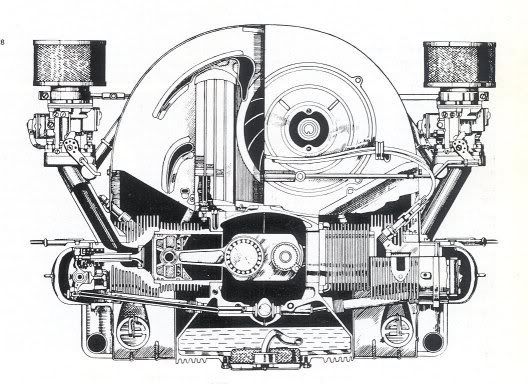
The above is a blast from the past, a 1950's Porsche 1.3/1,5 (roller crank!) Super engine. When VW guys take a look at it, they immediately see an engine they know...right down to the grandfather of the "Kadrons," actually 40mm Solexes. Kadron was just the name of the Brazillian company that sold a variant of the carbs beginning in the 1970's.
Porsche thought it had oil slosh control handled because of the design of the sump. Look how the sump narrows at the camshaft. The VW is the same.
356's had more oil capacity (3.5 liters with a later increase to 4.5) than a VW, helped because of a bypass filter system. And in 1960-61, they got whopping 36mm oil pumps.
Anyway, in 1960, Porsche made a huge improvement we all use today -- the windage pushrod tube. This is a tube with a simple but effective extension on the case end, which helps prevent oil from sloshing up from the sump into the heads.
An oil note: roller cranks could live with less oil pressure than plain bearing cranks, but Porsche developed the plain bearing crank to the point that we can get 7k+ out of one then and now.
When they dropped the roller cranks, they needed better oil control, and gave us the windage pushrod tube.
FJC
Hot, humid air is less dense than cooler, drier air. This can allow a golf ball to fly through the air with greater ease, as there won't be as much resistance on the ball.